
Hippo Staff Writer · Published 11 July 2024 · 5 min read
Why are South African roads so dangerous?
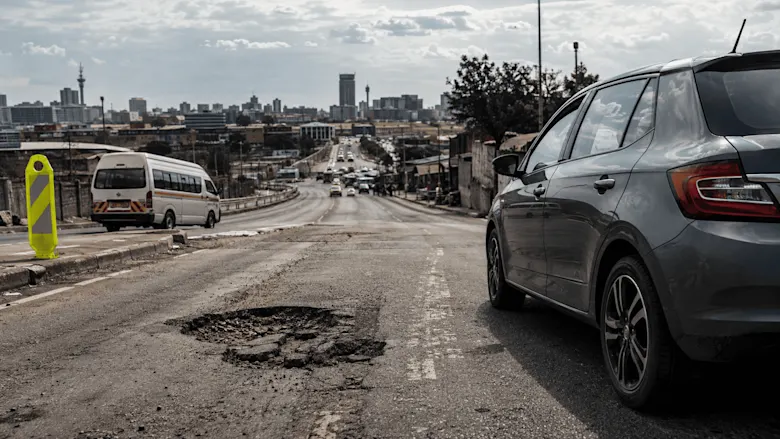
South Africa has dangerous roads, and that’s a fact. Our road fatality rate in 2023 sits at 19.39 deaths per 100,000 inhabitants, well above the global rate of 15.
We tend to think that we’re immune to bad accidents because we’re cautious drivers. We obey the speed limit, stop at red lights, and don’t drink and drive. The thing is: You might be careful, but the oncoming speed freak isn’t necessarily.
Neither is the impatient person behind you who’s careening left and right to try and overtake you on a blind corner.
It’s not just other drivers you have to be aware of, either. The UN says that bad road conditions and poorly maintained vehicles are two of the biggest culprits across Africa. When you add South Africa’s drinking culture into the mix along with our general disregard for the law, you end up with a recipe for disaster.
Here’s why SA roads are so dangerous.
Poor infrastructure
According to the Automobile Association (AA), potholes (surprise, surprise), inoperative streetlights, blocked stormwater drains, streams, and rivers that overflow due to pollution, plus overgrown, unkempt pavements and traffic islands, are all big problems.
For one, motorists who are going at speed have to swerve to avoid potholes. If that causes a crash, the accident is ascribed to human error. But it’s actually a road error caused by poor maintenance.
Blocked drains along with overflowing rivers and streams can make roads unusable. That can cause gridlock traffic and sudden stops, which have a ripple effect of driving causing more accidents.
Insufficient road markings and signage are another problem. When the markings and signs that control and direct traffic are ineffective, drivers might not know what lane they’re in or where to turn. That might mean they drive erratically and cause motor accidents.
Besides obstacles in the road, the fact that there aren’t enough pavements, pedestrian crossings, and streetlights to allow people to walk safely is an issue. The biggest lifesaver for pedestrians on the road is drivers being able to predict where they might be and see them there. Which obviously can’t happen if there aren’t pedestrian-friendly areas or proper lighting.
Unroadworthy vehicles
Around 15% of all accidents are caused because of vehicle defects and mechanical failures. This includes:
Burst tyres.
Faulty and dirty brakes.
Smooth tyres.
Faulty headlights and indicators.
Faulty steering.
Cracked or shattered windscreens.
Faulty and worn windscreen wipers.
Missing seats.
Missing seat belts.
Another big one is overloading. It might not spring to mind as something that affects your car’s roadworthiness, but it does. Every vehicle-whether it’s a car, minibus, bus, or other mode of road transport-is designed to hold a certain number of people. If you go over that limit, your car is automatically unroadworthy. And it can mean the difference between life and death for you, your passengers, and other road users.
Disobeying road rules
South Africans racked up over 8 million traffic fines in 2023 alone.
One excuse that drivers give is not knowing the rules of the road. Unfortunately, though, ignorance isn’t bliss. Plus, there are plenty of well-known rules that drivers simply flout.
For example, seat belt laws. 2017 stats show that only 33% of drivers and 31% of front-seat occupants wore their seatbelts. Considering that they’re proven to save lives, we should all be wearing them 100% of the time.
Speeding
South Africans clearly have a need for speed.
South Africans had 332,836 speeding fines in 2023. And according to the Road Accident Fund, 40% of South African drivers exceed the 120km/h speed limit, 80% the 100km/h limit and 90% the 60km/h limit.
Speed is a contributing factor in 75% of motor vehicle crashes. That’s because it reduces the amount of time that a driver has to react to events, like avoiding a pothole or pedestrian, on the road. It also tends to make accidents more fatal. The laws of physics apply here: The faster you’re travelling when you hit something, the more force will be exerted on your vehicle to make it come to a stop.
Drink driving
More than 12,000 drivers were arrested for driving under the influence of alcohol in 2023. Plus, almost 58% of road accidents happen because of alcohol: half of non-fatal crashes and 60% to 63% of fatal ones.
Inhibited faculties, like not being able to see straight or losing gross motor control (your arms don’t work so well), aren’t the only reason for drunk drivers causing more accidents. Having one for the road often makes drivers believe they’re the next Lewis Hamilton.
Drunk driving accidents are usually caused by excessive speed. Next, it’s running into pedestrians. Then it’s loss of control of the vehicle.
Coverage for the unexpected
How other people drive isn’t something you can necessarily control. But one thing you can control is having Car Insurance or Medical Aid for when things go wrong.
That way, at least you’ll know you’ll be financially protected in the case of an accident or emergency. Hippo lets you compare quotes from some of South Africa’s leading insurance providers to find the best deal. Why not try it today?
Sources
State of Road Safety in South Africa January 2023 to December 2023
Road Safety Week: African nations steer towards reducing deaths
Poor Infrastructure Equals Poor Road Safety
4 Common Causes of Road Accidents: Understanding the Risks
SA traffic cops dish out 8-million fines in 2023
Seat belt wearing rates in South Africa in 2017, by occupant type
Matrix Reveals South African Distracted Driving Statistics
Ways of Reducing Accidents on South African Roads
Why SA doesn't have a clear view of the extent of drunk-driving related fatalities - expert
This article is for informational purposes only and does not constitute financial, legal, medical or insurance advice. Hippo is a comparison site helping you evaluate quotes from trusted South African insurers. Always review policy details before making changes. Quotes are risk profile dependent and subject to annual review. No fees are charged for using Hippo’s comparison service. HAS (Pty) Ltd and HCS (Pty) Ltd are authorised FSPs. Terms and conditions apply.
Related Articles
2026-08-25
6 reasons to consider Scratch and Dent Cover in South Africa
A runaway shopping trolley in a parking lot. A gate that's slightly narrower and swifter than it looks. Someone else's bumper nudging yours at 5km/h while you’re in a parking lot. None of it is dramatic enough for a full insurance claim, but it still costs money to fix, and it still makes your car look a little less like the one you take pride in showing up in. That's the what Scratch and Dent Cover is built for.
Read More
2026-08-24
5 reasons to consider Tyre and Rim Cover in South Africa
Tyre and Rim Cover (also called rim insurance) is an add-on motor product that pays for the repair or replacement of tyres and rims damaged by road hazards such as potholes, debris and uneven surfaces. It's typically bought alongside your main Car Insurance policy, either as a standalone product or bundled in as an extra, rather than replacing your comprehensive cover.
Read More
2026-08-21
4 reasons to consider a Vehicle Tracker in South Africa
Somewhere in South Africa, a driver is handing over their car to someone who did not ask nicely. It happens roughly every 36 minutes, according to the latest SAPS figures, and knowing your number plate off by heart does very little to help once your car has vanished into traffic. However, knowing exactly where it is does.That is the basic logic behind Vehicle Tracking, and it is why so many South African drivers treat it as a given rather than an extra.
Read More
2026-08-20
5 reasons to consider Motor Warranty for your vehicle
Once your factory cover ends, and it always does, mechanical and electrical failures become your bill to pay. Extended car warranty cover is designed to bridge that gap by helping with mechanical and electrical breakdowns during the cover period.
Read More

Hippo Comparative Services (Pty) Ltd is an authorised financial service provider.
FSP number: 16357. Block A, Steyn City Capital Park, Erling Road, Riverglen, Dainfern, 2191
*Based on independent research by Kaufman Levin & Associates 2025.


© Copyright 2026 Hippo Comparative Services (Pty) Ltd. All Rights Reserved.