
Hippo Staff Writer · Published 9 February 2023 · Updated 9 July 2026 · 5 min read
How to spot a loan shark in South Africa
Hippo's quick bites:
Loan sharks are unregistered lenders who charge illegal, sky-high interest and trap you in debt.
Legal lenders must be registered with the National Credit Regulator (NCR) and stick to capped interest rates.
Know the red flags: no affordability checks, holding your ID or bank card, pressure to sign fast, "blacklisted welcome" promises.
Comparing registered lenders side by side on Hippo.co.za helps you find a legal, affordable Personal Loan instead.
What is a loan shark?
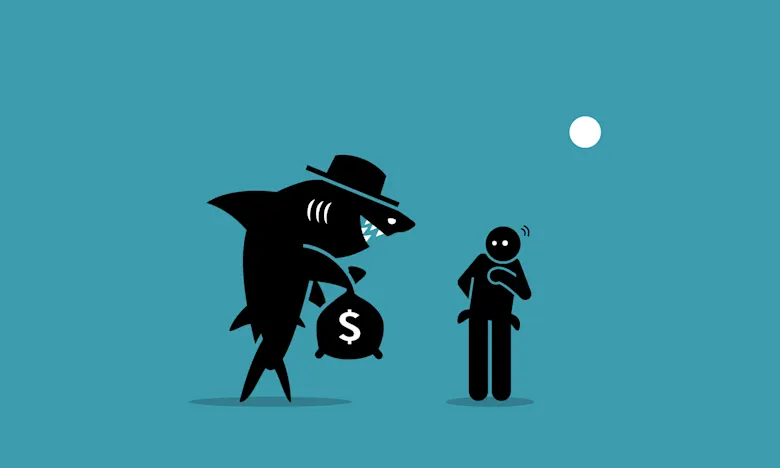
A loan shark is an unregistered lender who operates outside the law.
They lend money without checking whether you can afford to repay, charge interest far above the legal limit, and often use intimidation to collect. They're not registered with the National Credit Regulator (NCR), which means they're not bound by the rules set out by the NCR to protect you. And that's exactly how they keep you on the hook.
Loan sharks thrive when people are stretched, and right now a lot of South Africans are. Household debt now sits at around 63% of household income, and short-term "emergency" borrowing is climbing fast. Short-term credit grew by nearly 32% year-on-year in one quarter of 2024 alone. When money's tight and credit gets rejected, a quick "yes" from a private lender can feel like a lifeline. But that's where the trouble starts.
How does someone end up with a loan shark?
Usually through desperation, not carelessness.
Maybe you're self-employed, like approximately 17% of South Africans. You've had a few quiet months, your debit orders start bouncing and now your rent is due. You ask your bank for an overdraft, but when they run a credit check, they see that your credit score has taken a knock due to those missed debit orders. The answer from the bank is a firm no. Just as you're about to start panicking, a friend of a friend recommends a private lender who asks no questions and pays out fast.
The immediate panic might ease, but you've swapped one problem for a worse one: now you owe a loan shark, and they're merciless. To put the difference in perspective, a legal short-term lender is capped at 5% interest per month on a first loan (and 3% per month on subsequent loans), and unsecured Personal Loans are capped at repo rate + 21%. Currently, the repo rate is 7% (as of May 2026) which would make the interest rate cap 28%. A loan shark charges whatever they like because they answer to no one.
Legal lender vs loan shark: spot the difference
| Registered (legal) lender | Loan shark |
Registration | Registered with the NCR | Unregistered and off the books |
Affordability check | Checks your income and ability to repay | Skips affordability checks because they want you in debt |
Interest | Capped by the National Credit Act | Illegally high and uncapped |
Your documents | Requests bank statements and ID as part of the verification process | May (illegally) keep your ID, passport or bank card as “security” |
The contract | A written agreement with clear costs | Vague, verbal and “off the record” |
If things go wrong | You are protected by the law | Threats, harassment and intimidation |
Five ways to identify a loan shark
They ask to hold your ID, passport or bank card as security. This is illegal, full stop.
They pressure you to sign before an "offer expires." Rushed decisions are how sharks feed.
They offer to keep the loan quiet and off the record. All legal lenders must be registered with the NCR. An unregistered loan can land you on the wrong side of the law too.
They don't check your affordability. No bank statements, no credit check, no questions about whether you can repay.
Their marketing promises "blacklisted welcome" or "no credit check needed." Also illegal, and a dead giveaway.
How to borrow smart instead
You don't need to be a finance whizz to borrow safely. Just check a few things before you sign.
Confirm they're NCR-registered.
Every legal credit provider and registered lenders are required to display their NCR number. If you can't find it or verify it, walk away. If a lender's charging over the legal cap, you can report them to the NCR on 0860 627 627.
Ask for the full cost of credit.
Not just the monthly repayment (which is where we all tend to focus), but the total rand amount you'll pay back, including interest, initiation and service fees. A low monthly instalment can hide a high total if the loan runs over a long term, so that final figure is the number that actually matters.
Check the interest rate against the legal caps.
Anything above the National Credit Act limits is a violation, not a "special deal." If a lender can't explain how they arrived at your rate, treat that as a warning sign.
Compare more than one lender.
This is the big one. Rates, fees and terms vary a lot between registered lenders, and the cheapest headline isn't always the cheapest overall. A slightly higher interest rate with lower fees can work out better than the reverse, which is why it pays to see a few offers side by side before you commit.
Get loan-wise with hippo.co.za
Spotting a shark is half the battle. The other half is finding a lender worth borrowing from.
Thank goodness for Hippo's Personal Loans comparison tool. It puts registered lenders side by side so you can compare rates, repayments and terms in one place, instead of judging a single offer with nothing to measure it against. One lender's pitch always sounds reasonable on its own; the differences only show up when you see a few together.
It's also your best defense against the debt trap. The loan that's easiest to get is rarely the cheapest to repay. Comparing is how you spot the gap.
Already in deep? Hippo can help with that too
If you're already in a dire financial situation, that's still not a reason to panic. You have a few options worth knowing:
Consider Debt Consolidation. Instead of juggling several loans at different interest rates, you roll them into one affordable monthly payment. Just choose a reputable, registered provider, because there are sharks in those waters too.
Look into Debt Counselling. If repayments have become unmanageable, an NCR-registered debt counsellor can help restructure what you owe.
Don't ignore the problem. The earlier you act, the more options stay open to you. Lenders are far more willing to work with someone who reaches out before they fall behind than someone who's already missed several payments.
Whichever route fits your situation, the goal is the same: a repayment plan you can actually afford, rather than one that keeps you treading water.
This article is for informational purposes only and does not constitute financial, legal, medical or insurance advice. Hippo is a comparison site helping you evaluate quotes from trusted South African insurers. Always review policy details before making changes. Quotes are risk profile dependent and subject to annual review. No fees are charged for using Hippo’s comparison service. HAS (Pty) Ltd and HCS (Pty) Ltd are authorised FSPs. Terms and conditions apply.
Related Articles
2026-08-24
Different types of credit and how they affect your credit score
Most South Africans carry more than one kind of credit. Our wallets are crammed with cards for various shops, banks and loyalty programmes. A clothing account here, a credit card there, and beyond that there are debit orders for vehicle finance, insurance and perhaps a home or Personal Loan. What few people realise is that these different credit account types can affect your profile differently and determine your ability to borrow money.
Read More
2026-08-11
How do stokvels work in South Africa?
Stokvels are one of the largest informal savings systems in the world. The concept is simple, and that is exactly why it works. A group of people agree to contribute a fixed amount on a regular schedule. The pot rotates, or accumulates for a shared goal and everyone benefits. No credit check. No complicated contracts.
Read More
2026-07-17
How to file your income tax return in South Africa
Every year, around July, SARS opens filing season and millions of South Africans have the creeping realisation that they have tax returns to submit. Some people panic. Some do nothing and hope for the best. Some get a pleasant surprise in the form of a refund.The good news is filing is simpler than it used to be.
Read More
2026-07-10
How to choose the best savings account for you
Saving your money is easier with some banks than with others, with interest rates and bank fees affecting how fast your savings grow. Here’s what to look for when comparing savings accounts to ensure you get what best suits your needs.
Read More

Hippo Comparative Services (Pty) Ltd is an authorised financial service provider.
FSP number: 16357. Block A, Steyn City Capital Park, Erling Road, Riverglen, Dainfern, 2191
*Based on independent research by Kaufman Levin & Associates 2025.


© Copyright 2026 Hippo Comparative Services (Pty) Ltd. All Rights Reserved.