
Hippo Staff Writer · Published 18 May 2026 · 3 min read
April’s Top 5 cars: same list, very different feeling at the pump
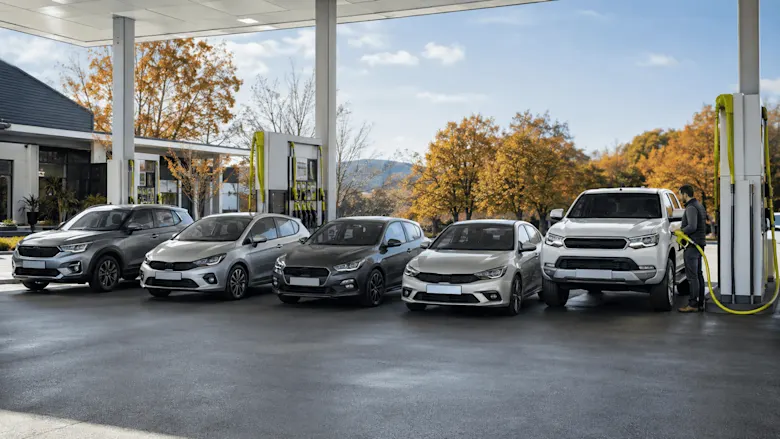
If you just look at the list, nothing here is particularly surprising.
The Toyota Corolla Cross is still leading. The Suzuki Swift, Volkswagen Polo Vivo and Hyundai i20 are all where you’d expect them to be. The Ford Ranger snuck back into the Top 5 to round things out.
These are familiar choices, and they’ve been consistent for a while now. What hasn’t been consistent is what it costs to run them.
Fuel did the talking this month
April already did enough damage to wallets across Mzansi. Petrol jumped by just over R3 a litre, and diesel took an even harder knock, climbing by more than R7. That’s the kind of increase that makes you look twice at the pump, just to make sure nothing’s gone wrong.
Then May arrived and said, “let’s do that again.” Yes really - another petrol increase, right on top of the first. That’s really what’s driving the pressure right now, making even the most economical cars more expensive to drive.
What that looks like on paper
Take the same Top 5 cars, and look at what a full tank costs now:
Car | Cost to fill the tank in April | Cost to fill the tank in May | Difference |
|---|---|---|---|
R 1,163 | R 1,332 | + R 169 per tank | |
R 860 | R 985 | + R 125 per tank | |
R 1,046 | R 1,198 | + R 152 per tank | |
R 860 | R 985 | + R 125 per tank | |
R 2,050 | R 2,584 | + R 534 per tank |
A full tank for a standard hatchback now sits right on the edge of R1,000. Anything slightly bigger moves comfortably past that. And if you’re driving something like a Ranger, you’re probably grateful for its off-road talents, because the price of filling that tank will have you on the rocks.
Some things change, some stay the same
The cars on the Top 5 list haven’t changed (much - yes, we see you’re back, Ford Ranger). The Corolla Cross is still a solid middle-ground option. The Swift and i20 still make sense if you’re trying to keep things affordable. The Polo Vivo is still everywhere, for good reason.
But with petrol where it is, the experience of owning these cars has changed. Maybe you think a bit more about combining trips. You notice how quickly the tank drops. You become more aware of how often you’re filling up, not just how much it costs when you do.
If there’s one bit of good news to hang on to, it's that insurance hasn’t shifted much. Costs are relatively stable compared to last month - you can see it in these average accepted premiums on Hippo:
Corolla Cross: R1,133
Swift: R1,251
Polo Vivo: R1,249
i20: R1,265
Ranger: R1,497
Some things are still in your control
There aren’t many places left to adjust once the big decisions are made. The car is bought, the repayment is what it is, maintenance arrives when it feels like it, and fuel… well, fuel has clearly decided it’s the main character this month.
That’s why people start looking elsewhere, even if it’s just to claw back a little bit of control. And one of the few places where that’s still possible is insurance. It’s not locked in the same way as everything else, but it’s very easy to ignore- especially when you’re busy processing the cost of filling up.
The irony is that this is often where a bit of flexibility still exists. It doesn’t require a big overhaul or a dramatic decision either. Just a quick check against what else is out there. In a month where fuel has significantly increased your spend, that small adjustment can help restore a bit of balance. It may not be a miracle fix, but it’s enough to make things feel slightly less one-sided.
Why not take this latest fuel increase as a sign to compare Car Insurance through Hippo, see what you’re currently paying versus what else is out there, and give yourself a bit of breathing room where you can.
This article is for informational purposes only and does not constitute financial, legal, medical or insurance advice. Hippo is a comparison site helping you evaluate quotes from trusted South African insurers. Always review policy details before making changes. Quotes are risk profile dependent and subject to annual review. No fees are charged for using Hippo’s comparison service. HAS (Pty) Ltd and HCS (Pty) Ltd are authorised FSPs. Terms and conditions apply.
Related Articles
2026-08-25
6 reasons to consider Scratch and Dent Cover in South Africa
A runaway shopping trolley in a parking lot. A gate that's slightly narrower and swifter than it looks. Someone else's bumper nudging yours at 5km/h while you’re in a parking lot. None of it is dramatic enough for a full insurance claim, but it still costs money to fix, and it still makes your car look a little less like the one you take pride in showing up in. That's the what Scratch and Dent Cover is built for.
Read More
2026-08-24
5 reasons to consider Tyre and Rim Cover in South Africa
Tyre and Rim Cover (also called rim insurance) is an add-on motor product that pays for the repair or replacement of tyres and rims damaged by road hazards such as potholes, debris and uneven surfaces. It's typically bought alongside your main Car Insurance policy, either as a standalone product or bundled in as an extra, rather than replacing your comprehensive cover.
Read More
2026-08-21
4 reasons to consider a Vehicle Tracker in South Africa
Somewhere in South Africa, a driver is handing over their car to someone who did not ask nicely. It happens roughly every 36 minutes, according to the latest SAPS figures, and knowing your number plate off by heart does very little to help once your car has vanished into traffic. However, knowing exactly where it is does.That is the basic logic behind Vehicle Tracking, and it is why so many South African drivers treat it as a given rather than an extra.
Read More
2026-08-20
5 reasons to consider Motor Warranty for your vehicle
Once your factory cover ends, and it always does, mechanical and electrical failures become your bill to pay. Extended car warranty cover is designed to bridge that gap by helping with mechanical and electrical breakdowns during the cover period.
Read More

Hippo Comparative Services (Pty) Ltd is an authorised financial service provider.
FSP number: 16357. Block A, Steyn City Capital Park, Erling Road, Riverglen, Dainfern, 2191
*Based on independent research by Kaufman Levin & Associates 2025.


© Copyright 2026 Hippo Comparative Services (Pty) Ltd. All Rights Reserved.